Sell Starter Home and Rent vs Move Up in Palm Coast: The Math
Selling a starter home and renting first can create flexibility, but moving up immediately often costs less when your equity meaningfully reduces the next loan. The better choice depends on your usable sale proceeds, the rent you would actually pay, and how long you would wait before buying again. For Palm Coast homeowners considering relocation or a larger home, the math starts with a realistic payoff figure, not the headline sale price. A temporary rental can be useful, but it needs to solve a specific timing or home-search problem.
The Palm Coast Market Overview
Palm Coast’s published postal-city-area profile offers useful context, although homeowners should use current listing, rental, payoff, and lending quotes for a personal decision (Palm Coast, FL).
| Metric | Current reading |
|---|---|
| Published median home value | $238,620 |
| Owner-occupancy rate | 78.75% |
| Renter-occupancy rate | 21.25% |
| Overall cost-of-living index | 103.5, compared with a U.S. average of 100 |
Why Sell Starter Home and Rent vs Move Up Is Harder Than It Looks
The sell starter home and rent vs move up decision is difficult because both options use the same equity in different ways. Selling first can turn home equity into cash and give you time to choose a replacement property carefully. However, that flexibility comes with rent, deposits, moving expenses, and the possibility that a suitable move-up home costs more by the time you are ready.
Moving up immediately avoids a second move and puts sale proceeds toward the next down payment right away. The trade-off is that you must commit to a purchase before having the benefit of extra search time. Palm Coast’s published median home value of $238,620 is a broad area figure, not a substitute for a property-specific sale estimate or a move-up budget.
The key comparison is not whether renting feels safer. It is whether the value created by waiting exceeds the all-in cost of waiting. That includes rent, storage, transition costs, and any additional borrowing required later.
Option A: Sell and Rent in Palm Coast
Selling and renting first works best when waiting has a defined purpose and a defined end date. Start with the expected sale price, then subtract the mortgage payoff, seller-paid transaction costs, agreed buyer credits, repairs, and moving expenses. The remainder is your usable equity, not the gross amount shown on the contract.
A homeowner selling near the published $238,620 area median home value may retain very different proceeds depending on the payoff balance. A seller with substantial equity could hold cash for a later down payment, a reserve fund, or relocation expenses. A seller with a larger remaining loan may find that most proceeds are needed for the next purchase.
Cash held temporarily may earn interest, but it does not reduce the balance of a future mortgage. Renting also creates a monthly housing cost that should be compared with the potential mortgage payment on a replacement home. Use live lease listings for homes with a similar bedroom count, condition, and location, rather than relying on a general rental average.
This route fits a seller who needs flexibility to coordinate a relocation, narrow down preferred Palm Coast neighborhoods, or wait for a specific type of home. It is less compelling when the lease period is open-ended and the equity will ultimately be used for the next down payment anyway.
Option B: Move Up Now in Palm Coast
Moving up now is usually stronger when sale proceeds are essential to keeping the replacement-home payment manageable. Applying usable equity at purchase lowers the loan amount from day one and may preserve more room in the household budget.
The meaningful price gap is the difference between your actual sale price and the specific homes that meet your next-stage needs. Palm Coast’s published $238,620 area median home value can provide background context, but larger homes, newer construction, location preferences, and community features can produce a much wider gap. A tailored comparison should use recent sale evidence for your home and active options that match your move-up criteria.
Your down payment directly affects loan-to-value. More equity deployed at closing generally means less principal financed and lower principal-and-interest costs over time. The right amount is not always every available dollar, because sellers also need reserves for moving, repairs, insurance, taxes, and unexpected homeownership costs.
Buying up immediately tends to suit a homeowner who has identified a strong replacement option, plans to stay long enough to justify transaction costs, and can coordinate the sale and purchase dates. It also eliminates a temporary lease, a second move, and the risk of becoming comfortable renting while replacement-home costs continue to change.
Sell Starter Home and Rent vs Move Up: Side-by-Side Numbers
| Comparison point | Sell & Rent | Move Up Now |
|---|---|---|
| Estimated net sale proceeds | Held as cash after payoff and transaction costs | Applied toward the replacement-home down payment |
| Monthly housing cost after the move | Lease payment, renters insurance, utilities, deposits, and possible storage | Mortgage payment, taxes, insurance, and applicable association dues |
| Equity retained or deployed | Retained temporarily until a later purchase | Deployed immediately to reduce the new loan balance |
| Break-even horizon | Depends on rent, two-move costs, and the benefit created by waiting | Depends on payment savings and planned ownership period |
| Best-fit seller profile | Seller with a specific reason to wait and a short rental timeline | Seller with a suitable replacement home and usable equity to deploy |
The calculation should begin with your actual payoff, current rental quote, and replacement-home budget. The published Palm Coast area median home value is $238,620, but individual results will vary by property and financing terms.
The Hidden Costs Most Sellers Overlook
-
Seller transaction costs: Net proceeds must account for the mortgage payoff, negotiated credits, title-related charges, repairs, and other contract-specific expenses.
-
Florida documentary stamp tax: Outside Miami-Dade County, the state rate is generally 70 cents per $100 of consideration. Using the $238,620 example sale price cited above, the tax would be about $1,670 before transaction-specific adjustments, according to the Florida Department of Revenue.
-
Two-move expense: Renting first can mean two moving days, security deposits, storage, utility transfers, and time away from work.
-
Delayed equity deployment: Cash reserves can be valuable, but cash held for a future purchase is not reducing the future mortgage balance.
How Sell Starter Home and Rent vs Move Up Timing Affects the Math
The sell starter home and rent vs move up calculation changes when the timing of your next purchase is uncertain. If you have a clear replacement-home target and your equity will materially reduce the amount financed, moving directly can prevent temporary housing costs from eroding that advantage.
If your next-home criteria are still broad, renting can buy time to compare locations, condition, commute needs, and monthly ownership costs without forcing a rushed decision. That benefit is real only when the rental period remains controlled. An open-ended lease can add months of rent, storage, and a second move without improving the eventual purchase terms.
Palm Coast’s published housing profile reports a 19.76% vacant-housing figure, but that measure should not be treated as a count of suitable rentals. A vacant home may be seasonal, unavailable, under repair, or not comparable to the home your household needs. Instead, compare currently available lease options with the actual homes you would consider buying.
The practical advantage shifts toward renting when waiting helps you avoid a poor-fit purchase. It shifts toward moving up when your usable proceeds reduce the next loan enough to outweigh the cost and disruption of a temporary lease.
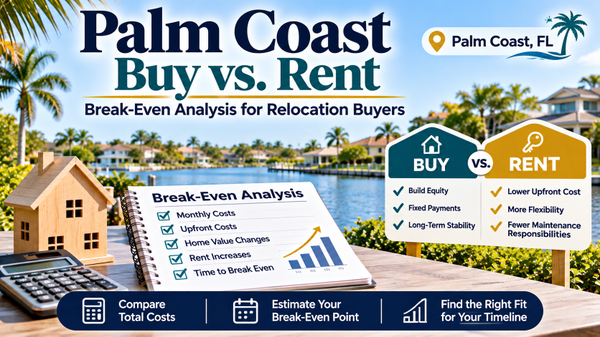
The Break-Even Test: When Does Renting First Pay Off?
Renting first pays off only when the financial or lifestyle benefit of waiting exceeds every cost created by the delay. Use your own figures in four steps.
Understanding the financial break-even point can help Palm Coast homeowners determine whether renting temporarily or purchasing another home makes more sense. Monthly rent, mortgage payments, insurance, maintenance, and the expected length of ownership can all influence the comparison. For a deeper look at these calculations, explore our guide to comparing the long-term costs of buying and renting in Palm Coast before deciding on your next move.
First, calculate usable sale proceeds by subtracting payoff, seller expenses, and agreed credits from the expected sale price. Second, estimate the full cost of the rental period: monthly rent multiplied by the expected number of months, plus deposits, storage, utility changes, and the second move.
Third, compare the move-up purchase you could make now with the purchase you expect to make later. Ask whether waiting changes the likely down payment, the type of home available, or the amount you would need to finance. If the future loan amount is effectively the same, rent is primarily an added expense.
Finally, set a maximum lease period. For example, if six months of rent and transition costs consume more cash than the value created by waiting, buying sooner may be the stronger option. If waiting helps you avoid an unsuitable purchase or produces a materially better move-up choice, that benefit may justify a short lease.
The assumptions matter: sale proceeds, rent, lease length, purchase price, reserves, taxes, insurance, and financing terms all change the answer.
Pro-Tip: In Palm Coast, usable sale proceeds after payoff and seller costs should drive this decision. That number reveals whether renting preserves useful flexibility or delays the down payment your move-up purchase needs.
Tax and Equity Implications in Palm Coast
Federal tax rules may allow a qualifying homeowner to exclude up to $250,000 of gain, or up to $500,000 for married taxpayers filing jointly. In general, the seller must have owned and used the property as a primary residence for at least two of the five years before the sale. The ownership, use, and partial-exclusion rules are explained in IRS Publication 523.
Florida does not impose a personal state income tax, but federal tax may still apply to gain that does not qualify for exclusion. Selling a current primary residence and renting before buying another home does not automatically eliminate the exclusion on the home being sold.
A later change in how a property is used can affect future tax planning. For example, converting a future primary residence into a rental property can change the ownership-and-use analysis and may introduce depreciation considerations. A tax professional can review the sale date, prior use, projected rental period, and records specific to your situation.
Planning Your Next Move in Palm Coast?
Deciding whether to sell your starter home, rent temporarily, or purchase a larger property starts with understanding your equity, monthly expenses, and timeline. Alina Pekarsky of Virtual Homes Realty helps Palm Coast homeowners compare their options and plan their next move with confidence.
Whether you're preparing to sell or exploring your next home, contact Alina Pekarsky or call or text (386) 445-9911 for personalized guidance on your real estate goals.
Frequently Asked Questions
Is it better to sell my starter home and rent or buy a bigger home in Palm Coast right now?
Moving up immediately is often stronger when your usable sale proceeds will substantially reduce the replacement loan. Renting first can be worthwhile when a short lease gives you a meaningful advantage, such as time to resolve relocation timing or avoid buying the wrong home.
How much equity do I need to make a move-up purchase work in Palm Coast?
You need enough net proceeds to support the planned down payment, purchase closing funds, reserves, and a sustainable monthly housing budget. Calculate equity after the mortgage payoff and seller expenses, not from the estimated sale price alone.
How long would I need to rent in Palm Coast for that strategy to beat buying up immediately?
The rental period should end before rent, deposits, storage, and two moving events exceed the benefit created by waiting. Set a defined lease timeline and compare its full cost with the improvement you expect in your eventual purchase decision.
What are closing costs for a home sale in Palm Coast?
Seller expenses can include mortgage payoff, negotiated credits, title-related charges, repairs, and Florida documentary stamp tax. Outside Miami-Dade County, documentary stamps are generally assessed at 70 cents per $100 of consideration.
Will renting in Palm Coast hurt my ability to qualify for a move-up mortgage later?
Renting does not automatically prevent future mortgage qualification, but the lease payment becomes part of your monthly obligations. A future lender will evaluate income, debts, reserves, and the projected payment for the replacement home.
Categories
Recent Posts